

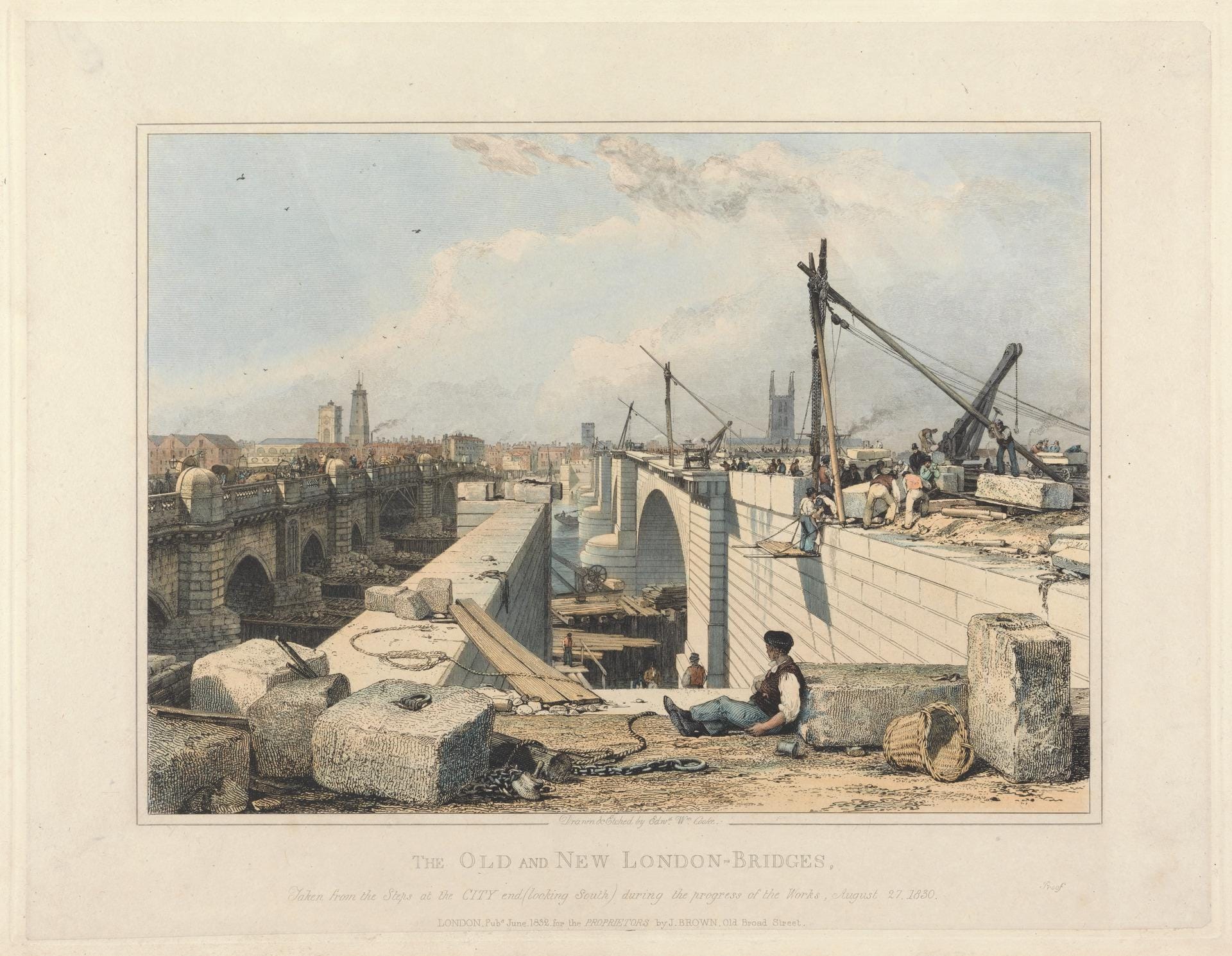
Old and New London Bridges 27 August 1830 - Edward William Cooke © Yale Center for British Art, Paul Mellon collection
Introduction
Standing on the Millennium Bridge that crosses the Thames between the City of London and Bankside and looking downwards at low tide reveals the old mooring posts of a former commercial port, together with countless fragments of past London lives going back to Roman times to be picked over by the mudlarks on the foreshore. These sights are a reminder of how long the river Thames and its traffic and adjacent transport to and across it have served London as a city, and continue to do so.
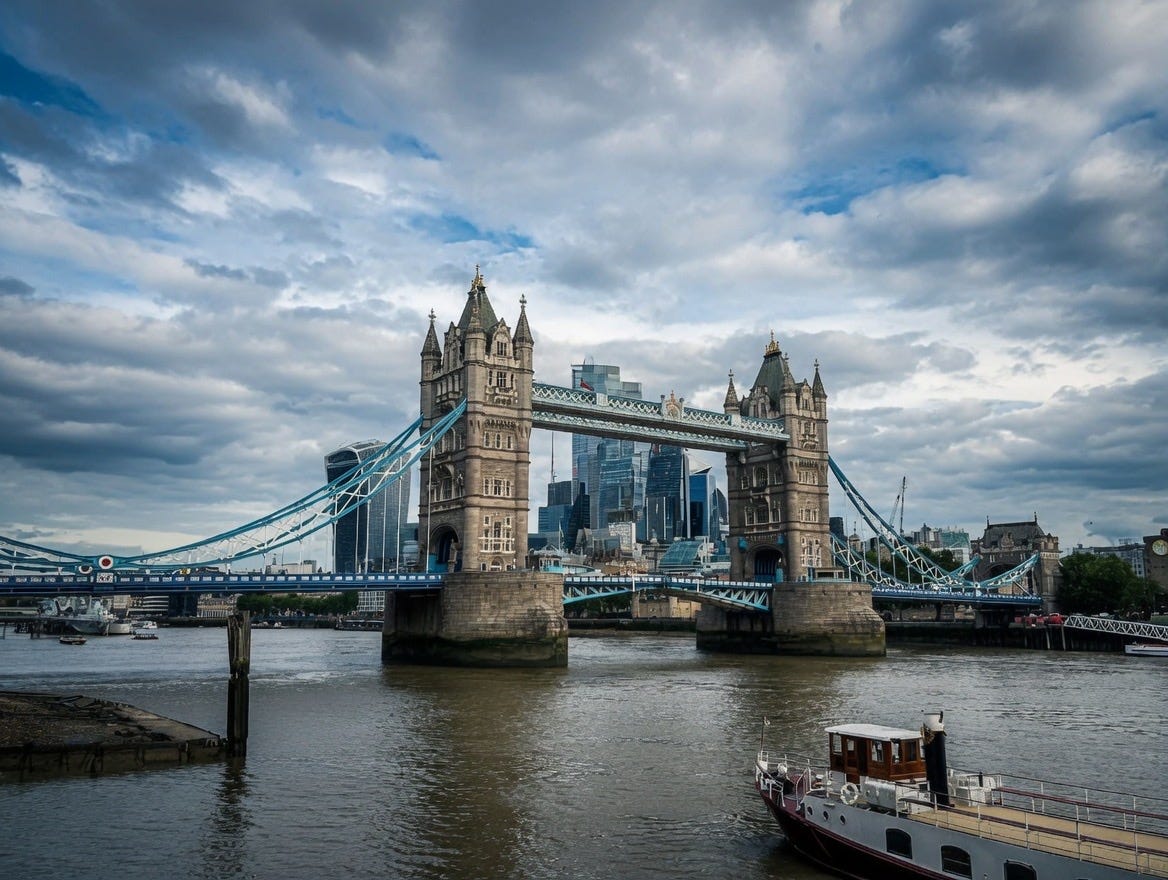
The Millennium Bridge is the newest of five bridges (the others are Tower Bridge, London Bridge, Southwark Bridge, and Blackfriars Bridge) in or adjacent to the historic City of London which belong to and are maintained by an ancient property trust, Bridge House Estates, now known publicly as the City Bridge Foundation. Its earliest constitutional document, a Latin charter bearing the Great Seal of King Edward I, dates from 24 May 1282. This charter established a perpetual trust for the maintenance and support of London Bridge, then a medieval stone bridge lined with timber-framed houses and shops. The historic core of the endowment of the trust consists of medieval gifts of land and money “to God and the Bridge”, tolls levied from crossing Old London Bridge and fees from fishing off it, and rents for occupation of the houses and shops on the bridge. Subsequent constitutional documents created similar trusts of the other bridges and transferred trusteeship of them to the City of London Corporation. The current value of this endowment is £1.5 billion. The trust in its modern name, City Bridge Foundation, was first registered as a charity under current law on 24 March 1994. Its trustee remains the City of London Corporation, which is also the elected local authority for the City, but in this capacity acts as a private law trustee not as a public authority.
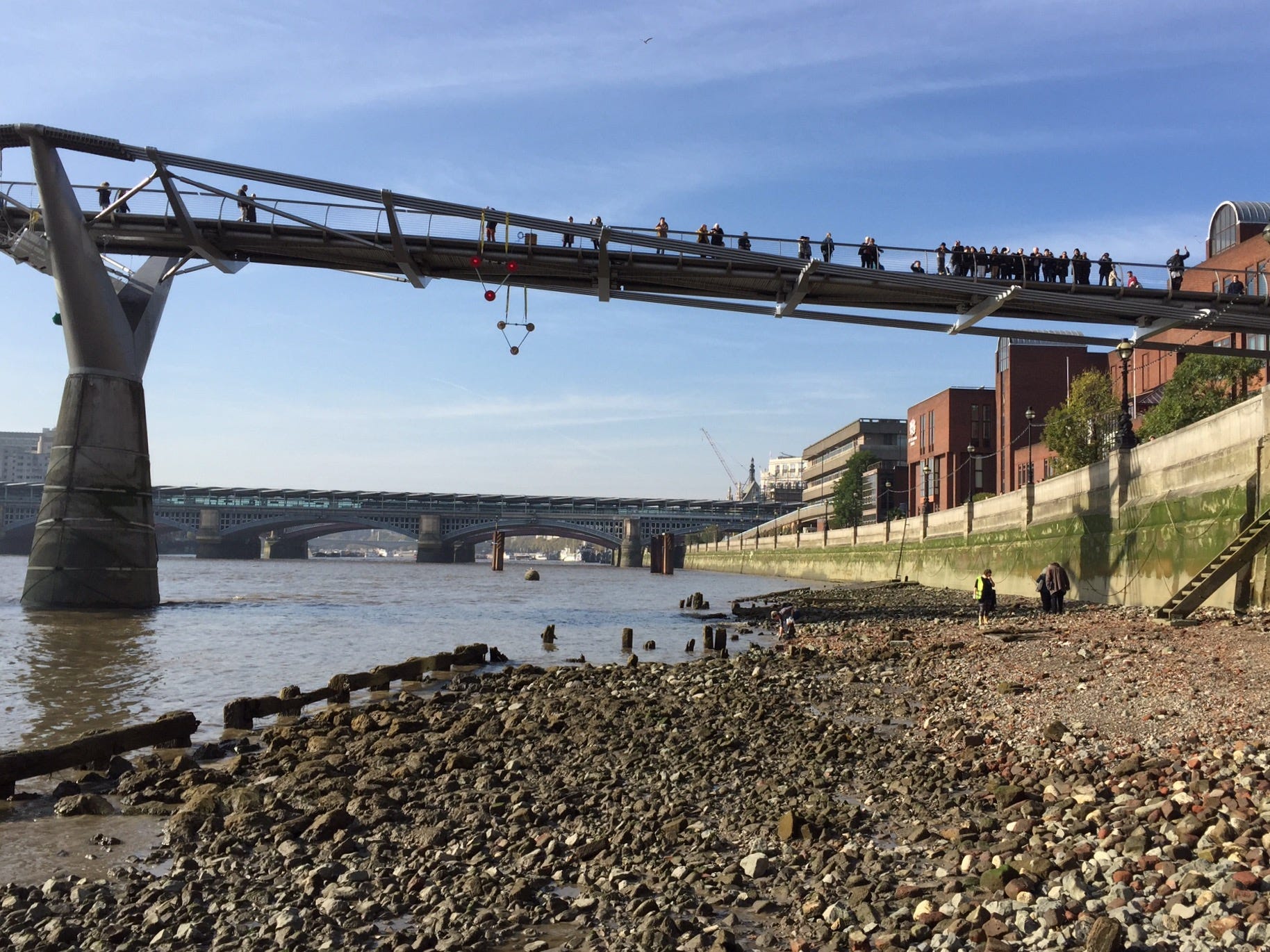
Mudlarks and old mooring posts on the foreshore under Millennium Bridge, London © Barbara Rich
The controversy
A comment article by Juliet Samuel published in the Times (£) on 21 October 2026, giving prominence to an idea first promoted by the Looking for Growth campaign and circulating in Substack essays and social media discussion over the past few months, has now thrust this charity into a highly-charged debate.
The gist of this is a complaint the charity is “squandering its millions on leftist causes” when it should instead be applying them to support the maintenance of one or more of the several other London bridges upstream of the City which are in urgent need of major repair. Looking for Growth have focused their campaign on Hammersmith Bridge in west London, which has been closed to vehicles since April 2019, with no prospect of re-opening for this traffic unless £300M is found and spent on it. This is a sum which the local authority responsible for the bridge, the London Borough of Hammersmith and Fulham, has said that it cannot raise, nor has it yet persuaded the government to provide it. In 1282 Hammersmith was an agrarian hamlet at some distance from the City of London, but it is now a densely-built urban area on the north bank of the Thames, with two tube stations, and an arterial road leading westwards to Heathrow and the M4 motorway and eastwards over Hammersmith Flyover into central London. Its distinctive Victorian bridge connects it with the leafy and tube-less south-western suburb of Barnes, and beyond it Roehampton, Putney, and the junction with the A3 main road south to Guildford and Portsmouth. It’s a very familiar place on my mental map of London from having grown up in the south-western suburbs and attended school in Hammersmith, crossing the bridge every day for years. There are similar urgent repair funding problems in relation to both Waterloo Bridge and Vauxhall Bridge, which are both major central London road traffic arteries, and fairground-like Albert Bridge with its decorative lights and pastel pink, blue and green superstructure, connecting Chelsea with Battersea.
At first sight, the argument that a charity which is established for the maintenance of some London bridges and which is so well resourced as to enjoy substantial surplus income should meet this need appears not only appealing but compelling. But the polemic of the Times article and many commentators on it omits or avoids both the legal constraints which currently govern the charity and the serious policy issues which would be engaged in making their desired change happen.
The original and extended purposes of the City Bridge Foundation.
As presently constituted, the City Bridge Foundation is responsible for the five named bridges only. It is not and never has been an all purpose fund for other London bridges or Thames river crossings, and all of its bridges other than the Millennium Bridge were wholly funded from its own original endowment derived from Old London Bridge. The Foundation funded the construction of the original (1769) and replacement (1869) Blackfriars Bridge, purchased the original Southwark Bridge in 1868 and funded its rebuilding in 1912-1921, funded the construction of Tower Bridge (1886-1894) and formally acquired the Millennium Bridge in 2002. Each of these acquisitions or constructions were made under primary or secondary legislation dealing with the bridge(s) concerned, with no wider obligation to acquire, build or maintain any other London bridges or Thames crossings. Until 1995 the City Bridge Foundation was legally bound to spend its money exclusively on the named bridges for which it was responsible, and it would require a formal change to its constitution for it to now take on responsibility for any further bridges.
In 1995 the constitution of the City Bridge Foundation was formally changed, extending its purposes beyond the maintenance and rebuilding of its then four London bridges. This 1995 extension applies only to the amount of surplus income arising in any year after the charity has met its primary obligation in relation to the now five bridges. It has no effect at all on the charity’s permanent endowment, which remains reserved for bridge maintenance and, if and when necessary, rebuilding of those now five bridges. Juliet Samuel’s article quotes from the charity’s most recent annual report and accounts that in the year ending 31 March 2025 “bridges maintenance projects were deferred into future years” and seems to regard this as an admission of improper prioritisation of the non-maintenance grant expenditure, but from elsewhere in the report it appears that some projects in that year were deferred for genuine operational reasons (Blackfriars delayed by Tideway sewer navigation issues, Tower Bridge delayed by materials shortage, Millennium Bridge by tender review), and that the trustee has a 50-year maintenance plan and reserves to meet its primary obligation for the five bridges, and is spending on their maintenance accordingly.
The 1995 extension giving additional purposes for spending surplus income
These are the terms of the 1995 extension to the charity’s purposes:
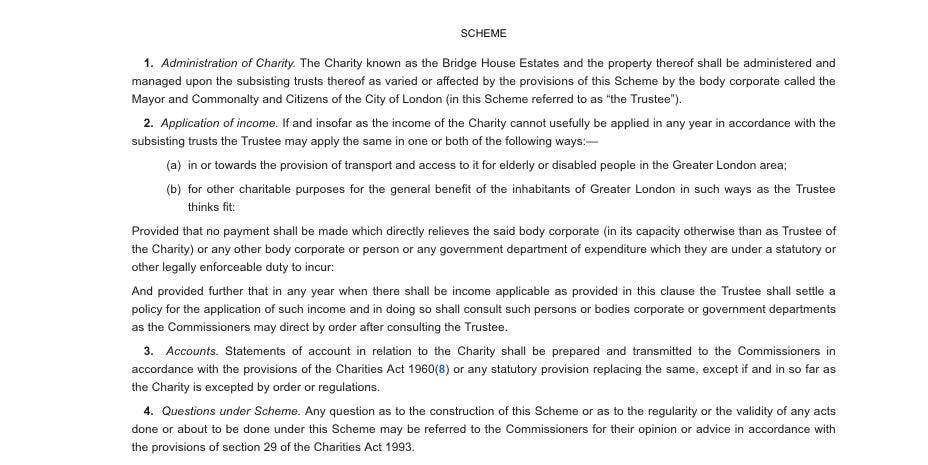
As is obvious at a glance, these terms are not in any way expressly either linked or limited to bridge-building or repair. Although those activities might in theory be included in both “the provision of transport and access to it” and “other charitable purposes for the general benefit of the inhabitants”, in practice the words “provided that no payment shall be made which directly relieves [the City of London Corporation in its capacity as local authority] or any other body corporate or person or any government department of expenditure which they are under a statutory or other legal obligation to incur” mean that the City Bridge Foundation cannot use any of its surplus income for a project such as repairing Hammersmith Bridge, which is the legal responsibility of the London Borough of Hammersmith and Fulham as highway authority. Other London boroughs have the same legal liability as highway authorities in relation to other upstream bridges, in some cases shared with the Department for Transport and/or Transport for London as part of the Greater London Authority Road Network of strategic bridges and tunnels across the Thames.
As is also obvious, clause 2 (b) of the scheme gives the Trustee an enormously wide power of selection and decision-making from many potentially qualifying activities benefiting a very large Greater London population. In addition to adopting its policy for making donations out of surplus income, as required by the clause 2, the Trustee has been transparent in making the donations and recipients public on its website.
Both the terms of the 1995 departure from bridge building and maintenance and some of the specific donation decisions made by the Trustee, in particular under the Standing With Londoners policy it adopted in 2025 which establishes the charity as a social justice funder, have fuelled the argument that London’s bridges are being “sold down the river”, to adopt the pejorative language of the Times headline. Much, but not all of this argument is driven by right-against-left political outrage of a type which has a long lineage (eg the notorious disapproval of the 1980s Daily Mail for Islington Council’s purchase of “gym mats for lesbians”). In this case, much of the outrage is further underpinned by widely-held misunderstanding of both the process and the principles by which a charity’s purposes can be legally changed.
Charitable trusts and cy-près
As charitable trusts are trusts for purposes rather than for people, and are perpetual in their existence, it is obvious that the law needs to deal with the problem of original charitable purposes becoming obsolete over time, or charities finding themselves with a surplus of resources over their needs to fulfil their purposes. The solution in English law to this problem is the law of cy-près – a Norman French word meaning “as close as possible [to the original purposes of the trust]”. Modern professionally drafted charitable trusts and gifts to charities in wills usually have clauses written into them anticipating the possibility of this problem arising and directing the trustees what to do with their trust property if it does. But there are still many old charities which do not have such provisions, and which require their trustees to apply either to the Charity Commission or the High Court to make a cy-près scheme for them.
Cy-près - process
Because the constitution of the City Bridge Foundation in part consists of primary legislation relating to its specific bridges, although the Charity Commission can draft a cy-près scheme for it, the scheme has to be formally approved by a Minister and given effect by Parliament in the form of a statutory instrument. The 1995 City Bridge Foundation cy-près scheme was formally approved by Michael Howard, then Home Secretary in the Conservative administration of John Major, and was laid before Parliament and came into force as The Charities (The Bridge House Estates) Order 1995 SI 1995/1047. It is worth detractors of the 1995 scheme bearing in mind that it was made under a very far from left wing government, and in a process with an element of publicity, public consultation and democratic endorsement to it. No one appears to have objected to or argued against it at the time.
Cy-près - principles
The modern English law of cy-près is now codified in the Charities Act 2011, largely reflecting the previous statutory and common law in force in 1995. Charity trustees have a duty to take steps to apply charity property cy-près where an occasion for doing so arises. The occasion which arose in this charity in 1995 was the generation of significant income surplus, meaning that the original purposes of the charity provided a use for part only of its available property, with the surplus otherwise simply accumulating in a sterile fund.
The contemporary principles which shape the terms of a cy-près amendment or extension to a charity’s purposes are set out in section 67(3) of the Charities Act 2011:

s67(3) Charities Act 2011. Note that this precise statutory formulation was not in force in 1995 and puts greater explicit emphasis on current social and economic circumstances than the former common law rules
Remaining close to the founder’s wishes (and it is the founder’s and not subsequent donors’ wishes which matter here) for a charity is an important part of cy-près. But the dead hand does not have the literal last word. It is not axiomatic that any extension of the City Bridge Foundation’ charitable purposes should have been limited to bridge-building and repair in Greater London, as many people understandably think it should have been. The 1995 scheme was dealing with pure surplus after the charity had exhausted its primary obligations to repair its own bridges. Other existing bridges had their own public sector funding arrangements. In that context the drafting of the scheme reads as a reasonable attempt to broadly reflect the basic intention underlying the original foundation, or to give effect to “the spirit of the original gift”.
As the 1995 cy-près scheme was not made by a judgment of the High Court, there is no public record of the reasoning which led to it being made in the terms that it was, nor have I been able to find a convenient public archive of the process. However, it is possible to make some reasonable conjectures from the known facts and from the Charity Commission’s operational guidance on application of property cy-près about the thinking of both the trustee and the Charity Commissioners behind the scheme.
- It was not a scheme extending the charity’s role in bridge building or repair to other London bridges because by 1995 liability for major infrastructure such as Thames road bridges was already largely firmly in the public sector. This is consistent with the inclusion of the proviso prohibiting the City Bridge Foundation charity from relieving any other body of its legal obligations, preserving the funds for charitable purposes. On a broader canvas, the history of English charity over centuries has been one of state or municipal capacity extensively replacing private philanthropy as the provider of major public services to a growing population: education and healthcare being obvious examples of this. As for what is now but was not in 1282 called critical infrastructure, some of the earliest English charities legislation, the Statute of Charitable Uses 1601, treated “the repair of bridges, ports, havens, causeways, churches, sea-banks and highways” as charitable purposes. Much of this list is now extensively funded by the public sector. It would have been reasonable for the trustee and the Charity Commission to take the view in 1995 that the City Bridge Foundation’s surplus income should be spent in ways which did not duplicate or relieve public sector liability for public realm works, and which dealt with any potential conflict of interest between the City of London Corporation as trustee of the City Bridge Foundation and as a local authority. It is true that the charity did take on a new bridge after 1995, but this was very different from the existing upstream road bridges. The Millennium Bridge is a purpose built pedestrian bridge, principally funded by National Lottery money via the Millennium Commission and with a plan from its conception for the City Bridge Foundation to take it over. A pedestrian bridge is neither likely to need such extensive repair as a road bridge, nor to cause similar traffic problems when closed for repair. It is also geographically in the City of London.
- The City Bridge Foundation’s income surplus was by definition susceptible to fluctuation in the light of its existing bridge repairing obligations from year to year, and in investment conditions affecting its income stream. This is not a charity which solicits donations from the public. Its modern income comes from its property and investment holdings. A cy-près scheme for surplus income which gives the trustee a very broad discretion allows it to adapt to available funding constraints and to deal with what might be a very large surplus without having to apply for a further scheme in the future. Discretionary grants to other organisations can be made on a one off or short term basis and are very different from a fixed liability commitment such as bridge repair. Of course the exercise of such a discretion by a trustee is a value judgement or series of value judgements with which anyone may (and many people do) strongly disagree, and the exercise also calls for good governance and isn’t beyond criticism or blunder in that respect either (although as the charity’s statement of 22 October 2026 asserts, there is nothing in the insinuations made in the Times about any funding of an organisation associated with proscribed organisation Hamas).
- The City Bridge Foundation itself now describes the effect of the 1995 scheme as “bridging the river and bridging London’s inequalities” and promotes the fact that “the charity has since [1995] awarded over £900 million to charitable organisations working to tackle inequality and injustice across London.. City Bridge Foundation has funded projects tackling disadvantage in every Greater London borough.” This appears to be the trustee’s own interpretation of “the spirit of the original gift” and it both relies more strongly on the metaphor of “bridging” than on any more solid construction of literal bridges, and is to an extent an interpretative gloss on the actual words of clause 2(b) of the scheme, which are entirely general. It also reflects a significant change in charity law since the 1995 scheme was made, which was the expansion of recognised charitable purposes by the Charities Act 2006 to include the advancement of human rights and the promotion of equality and diversity, and a specific reference to the relief of those in need by reason of any disadvantage.
Was the 1995 cy-près scheme a mistake?
It is being vigorously argued by some commentators that the 1995 scheme was a mistake which should now be reversed.
Clause 2(a) of the 1995 scheme has a clear conceptual association with physical bridges and “the spirit of the gift” to facilitate transport, and that appears to have been the primary focus of the early years of the operation of the scheme. Its first grant made in September 1995 was to a mental health charity to buy a new minibus, and the image of it reproduced on the website page shows that it was made in the category of transport and access defined by clause 2(a) of the scheme.
Clause 2(b) of the 1995 scheme is the type of wide sweeping-up clause quite often found in modern trusts to avoid ever having to apply for a cy-près scheme. But is its presence in such a scheme justified? The Charity Commission’s current operational guidance says “we should exercise caution where a proposed change might be a significant departure from the founder’s intentions”. In Zedra Fiduciary Services (UK) Ltd v HM Attorney General [2023] EWCA Civ 1332, one of the few modern cases decided by the courts, the Court of Appeal upheld the judgment of the High Court that the National Fund created in 1928 with the impossible aspiration of paying off the post-First World War national debt should be applied cy-près towards that purpose, by direct payment to the Treasury, and not to a proposed new UK-wide charitable trust with very similar extensive discretion over its application to clause 2(b) of the 1995 Scheme. The Court of Appeal considered that all three of the section 67(3) cy-près factors pointed towards paying the fund towards reduction of the National Debt, and expressed some caution about the width of the objects of the proposed charitable trust, which were neither close to the original purposes of the fund or in the spirit of the gift. It was no part of the founder’s intention to create a permanent endowment fund for general charitable purposes. But there are significant differences between the City Bridge Foundation and the National Fund case. The City Bridge Foundation cy-près scheme is dealing only with surplus, and a scheme which restricted its use to bridges and similar physical infrastructure would arguably not be “suitable and effective in the light of current social and economic circumstances” given the comprehensive public sector liability for this expenditure. There is also an argument that the trustee’s “bridging inequalities” metaphor, although inventive, is closer to the spirit of the original gift than was the case in the National Fund discretionary trust proposal.
All things considered, I do not think that the 1995 scheme itself was in some way immoral or a historic mistake either because it departs from bridge-building and repair or because it is sufficiently broadly expressed to permit grants to be made for specific charitable purposes which cannot have been contemplated at the time of foundation of the trust.
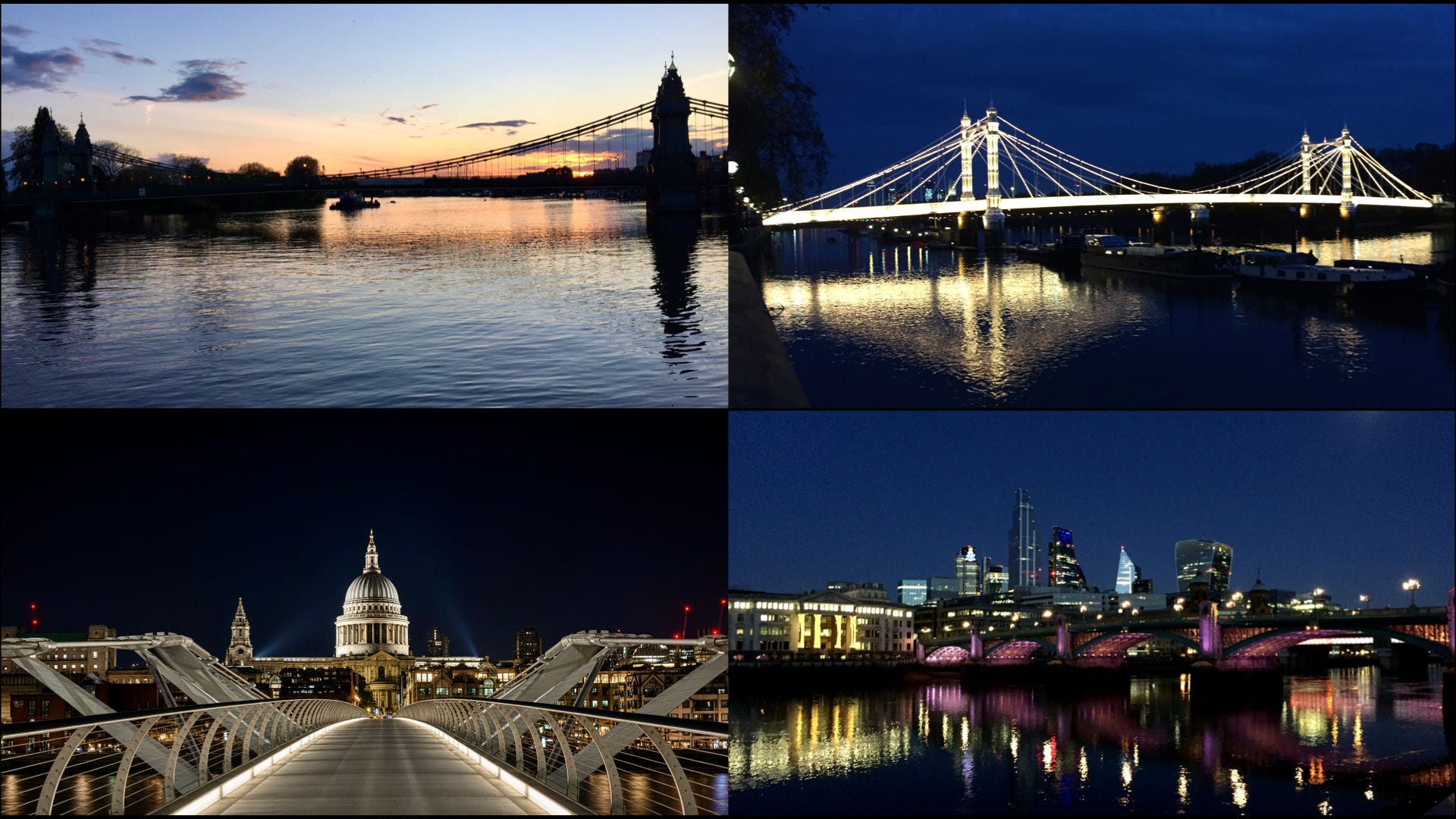
Hammersmith Bridge, Albert Bridge, Millennium Bridge, Southwark Bridge © Barbara Rich
The future
The Looking for Growth campaign is not the first to suggest that Parliament should compel the City Bridge Foundation to fund building further bridges. A century ago, in February 1926, John Scurr, the Labour MP for Stepney Mile End asked the Minister of Transport whether he was aware that the trust had considerable funds in its possession which could only be used for building and maintaining bridges within the City of London boundary and whether he would consider promoting legislation for making these funds available for building bridges in other parts of London? The minister’s response was that he was not sure that the MP had correctly described the restrictions of the trust and that he did not propose to promote legislation about it anyway.
As things stand now, the City of London Corporation as trustee of the City Bridge Foundation has no duty to apply for a further cy-près scheme, because no obvious occasion for such a scheme has arisen, nor could the Attorney General apply for a scheme without a cy-près occasion arising. The charity still meets its primary objects and the 1995 scheme enables it to deal exhaustively with any income surplus that may arise. Nor has the trustee shown any public inclination to voluntarily apply for a scheme permitting the City Bridge Foundation to take on or contribute to any obligations in relation to any of the upstream bridges or any other Thames river crossing. The consequence of that is that the proposal articulated in Juliet Samuel’s article and enthusiastically promoted by Looking for Growth and others would have to take the form of primary legislation effectively overriding the provisions of the City Bridge Foundation’s existing charitable trusts and imposing obligations on the charity which are currently unequivocally public sector legal liabilities.
Although Parliament could in principle legislate for this, it would be a thoroughly undesirable legal precedent to establish, and would be likely to cause concern to donors and trustees of other well-endowed charities. When the National Health Service was created in 1948, Parliament changed the terms of and effectively nationalised former hospital charities, but it did so in order to create state capacity in the form of a universal health service paid for out of taxation, in other words to augment and replace charitable provision, not the reverse, which is the substance of this proposal. Both state and municipal authorities have the power to raise taxation and to issue bonds to raise debt finance. Charities can do neither of these things. There are other precedents of Parliament legislating to change the objects of old private charitable trusts, most significantly the extensive mid-Victorian modernisation of education in the Endowed Schools Act 1869, a law which “could turn a boys’ school in Northumberland into a girls’ school in Cornwall”. But these were not reforms which substantially shifted the financial burden of existing public sector provision onto the charities, as would be the case here. It would also create a bad precedent, or moral hazard, in establishing an example of the public sector avoiding its liabilities by imposing them on a well-run charitable organisation.
These are issues of principle with which enthusiasts for the “City Bridge Foundation to Hammersmith” proposal seem generally disinclined to engage. And however vociferous their objection to the trustee’s current grant-making policy for the 1995 scheme, ordinary members of the public don’t really have anywhere to take their objections, other than to attempt to seek scrutiny via the Charity Commission of any actual allegation of impropriety or failure of good governance in decision-making.
Conclusion
Reasonable debate about the breadth of the 1995 cy-près scheme for this charity or the exercise of its trustee’s discretion over an annual distribution of £81.5M of surplus income in y/e 31 March 2025 or any other sum in any other year is one thing. But much of the discourse prompted by the Times article is simply misinformed hyperbole and outrage, including in posts made to social media by both the shadow justice secretary Nick Timothy MP and the shadow minister for culture (a portfolio which includes charities) Rebecca Paul MP, and other Conservative MPs. People aspiring to take those roles in government should be better briefed on the legal realities of the City Bridge Foundation than this. And the line from Juliet Samuel’s article that “We may not yet have feral youth smashing in shop windows like France but make no mistake: this is looting on a vast scale” or her social media post promoting it as “an incredible tale of how an ancient Royal charter charity founded to look after London’s bridges was hijacked by left-wing causes” simply trivialises the real harms of genuine crimes of looting and hijacking. Cy-près needs to be de-sensationalised in this discourse.
Barbara Rich
24/25 October 2026
NOTES: (1) This Substack is written as a general commentary and is not intended to be and should not be relied on as professional legal advice. It is also written as independent commentary based on material in the public domain. I have no role or interest in the City of London Corporation or the City Bridge Foundation or any organisation which has applied for or obtained a grant from its funds.
(2) I originally published this Substack on Saturday 24 October 2026. I have made some subsequent editorial revisions to introduce sub-headings, to extend the discussion of the 1995 cy-près scheme, and to add some further detail on other points following responses on social media to first publication, but the overall shape and argument remain unchanged.
(3) Since first publishing I have also read Richard Brown’s essay: London cannot let its bridges keep on falling down and am linking to it as useful reading material on the subject.
When I was one of the legal advisers on local government issues in the old DOE I was warned that the City of London considered that, having been established before Parliament, they were not necessarily subject to Parliament's legislation. It may be caution around this claim that means that the City has long had special status in local government legislation, and has been free of the periodic reorganisations that have plagued other local authorities.
But you are right about the City Bridge Foundation. The real issue is the very serious problems with the definition and regulation of the charity sector, which it has become a black hole for financial and political shenanigans.
Hi Barbara, I work for City Bridge Foundation and want to thank you for your insightful, informative and well researched article. I was hoping to reach out to you, is there a way we could do that?